
AI is becoming part of almost everything we do: email, engineering, sales, research, marketing - and maybe a bit of this blog post. Every ChatGPT query ultimately happens somewhere physical. Servers consume electricity. They generate heat. Data centers use water to remove that heat. And the power plants supplying all that electricity have water, carbon and community footprints of their own. [4]
So we wanted to answer one simple question: What is the environmental impact of an individuals AI use, and can composting offset it?
Getting to an answer turned out to be surprisingly difficult. Unfortunately, AI companies are fairly guarded when it comes to their environmental impact, and the amount of compute required varies enormously depending on what you ask the model to do. So, we worked through the available research, made our assumptions explicit, and did a considerable amount of math. [3, 4]
The result shocked us.

Under the assumptions in this article, the environmental benefit of composting considerably outweighs the harm generated by AI use on an individual level. [1-4] Before getting into the comparison, we want to clarify a few key assumptions. We will keep them simple here. If you want to nerd out on the equations, sources, and caveats, the second half of this article is for you.
Start with one year of food scraps
EPA data estimates that the average American wastes about 256 pounds of food per year. If we assume that food would otherwise go to a landfill, EPA's WARM model shows that composting it instead avoids producing roughly 83 kilograms of CO2-equivalent emissions. [1, 2]
83 kilograms of CO2e is a number that may not mean much until you give it some context. Using the electricity comparisons later in this post, it is roughly equivalent to running a 480 kWh/year refrigerator for about six months - or leaving a 10-watt LED light on continuously for about 2.7 years. It should be noted this is in the US. If you are in the UK, these numbers would be significantly higher due to more efficient grid and energy infrastructure. [4]
Now add AI
Every AI prompt requires computation, and computation requires electricity. Exactly how much is surprisingly difficult to pin down.
A simple ChatGPT prompt, rewrite this sentence, or find me a dinner spot nearby, is nothing like asking a reasoning model to analyze hundreds of pages, write software, use tools, and reason through a complicated problem. For a simple text query, one widely cited estimate from Epoch AI is about 0.3 watt-hours. To help conceptualize this for more complicated compute issues, we converted this into a energy consumption per token as well, landing at roughly 0.6 kWh per million tokens. [3, 4]
AI also consumes water.
The obvious image is a giant data center using water to cool rows of hot servers. That does happen. But one of the more surprising things we found is that, under the Berkeley Lab assumptions used here, most of the modeled operational water footprint does not come from cooling the data center. It comes from generating the electricity. [4]
The estimate we use is roughly 0.375 liters of water consumed per kWh for direct data-center cooling versus 4.52 liters per kWh associated with electricity generation. In other words, roughly 92% of the modeled operational water footprint comes from producing the electricity and only about 8% from cooling the computers themselves. [4]
It should be noted that the amount of water withdrawn for cooling the data centers is much higher than the amount consumed. In most scenarios, the withdrawn water can be returned to the body it came from with minimal environmental impact, however in some scenarios, this withdrawal has considerable environmental impact as well - think pulling from an aquifer.
Compost has a water story too
The composting process is not water-free. Compost piles need moisture, and some facilities add water during processing. Other facilities rely heavily on moisture already in the feedstock, captured rainwater, or recirculated leachate. [5, 6]
However, the positive impact of compost on soil's water-holding capacity significantly outweighs this effect. In practical terms, adding compost makes the soil become a better reservoir: more rainfall and irrigation can stay in the root zone instead of immediately draining away or running off. [6, 7]
Saying compost literally "creates water" would be an overstatement. But by improving soil water retention, compost can make the water we already have more useful. [6, 7]
Under the illustrative agricultural scenario we modeled, the finished compost produced from one person's annual food scraps could reduce irrigation demand by about 331 liters per growing season. After subtracting an estimated 67 liters of composting process water, that leaves a potential net irrigation-supply benefit of about 264 liters. That number can vary enormously with soil, climate, crop, compost quality, and irrigation practices, so think of it as an example rather than a universal constant. [5-7]
* The +264 L figure is a conditional net irrigation-supply scenario, not a verified freshwater-consumption saving. Improved soil water storage can recharge repeatedly; it is not an annual water-savings figure by itself.
† Token figures count generated tokens across calls, including hidden reasoning - not a combined input/output/cached-token total. The 10x case is an assumed sensitivity, not a measured commercial-model benchmark. Actual intensive-use equivalents can fall outside these examples.
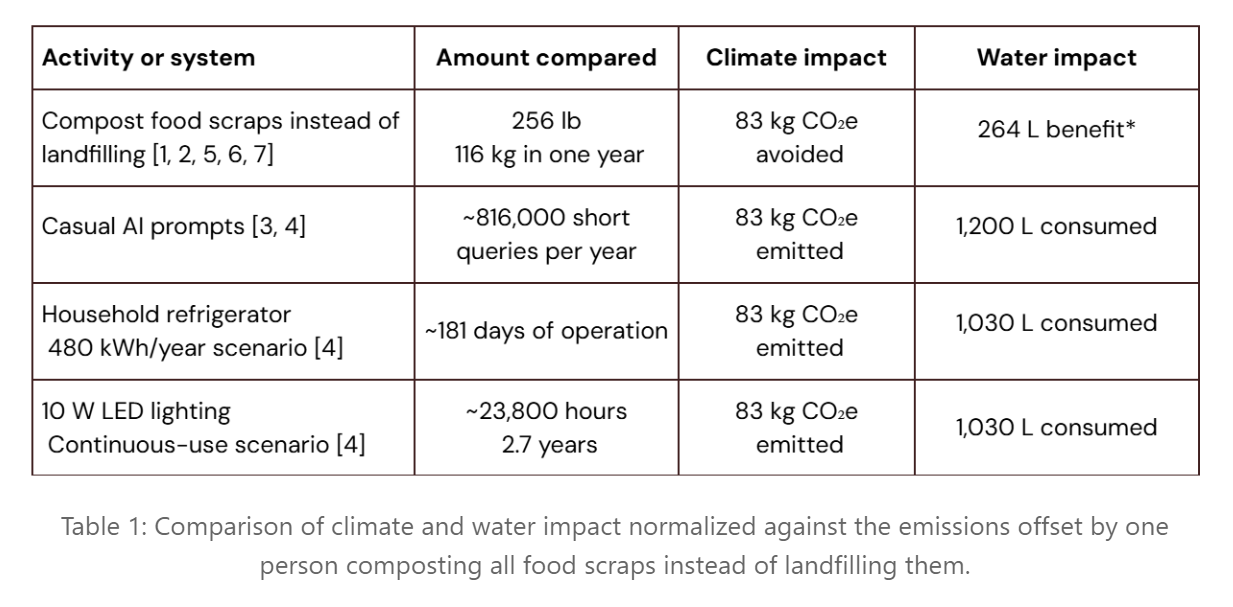
And this is where things get interesting...
Composting one person's annual food scraps instead of landfilling them produces a climate benefit equivalent to the electricity-related emissions of roughly 816,000 simple AI prompts under our assumptions. Another way of expressing the same energy budget is roughly 408 million generated AI tokens at the reference efficiency we used. [1-4]
816,000 prompts is an absurd number of questions.
Spread across a year, it is about 2,236 prompts every day. If you used AI for eight hours a day, seven days a week, you would need to ask it a question roughly every 13 seconds for the entire year to get there. [3, 4]
For people using AI for more demanding work; coding, engineering, research, analysis, creating graphics, or complex business problems, the comparison becomes less tidy because those tasks can consume much more computing power than a simple prompt. That said, 408 million tokens is enough to perform over one hundred complicated AI queries every single day, 365 days per year. [3, 4]
The water comparison is less overwhelming, but still surprisingly strong. Using the water factors in this article, the potential 264-liter irrigation-supply benefit associated with composting a year of food scraps is comparable to the operational water footprint of about 180,000 simple AI prompts - roughly 500 prompts per day for a year. [3-7]
The average AI user only issues 10 to 20 prompts per day, meaning that the simple act of composting dramatically outweighs the negative environmental impacts of our AI habit.
None of this means we should shrug at the environmental impacts of AI just because we compost. Data centers can place substantial demands on electrical grids and water supplies, and that weight is disproportionally carried by the communities nearby. On top of that, data centers are frequently and disproportionately located in low socioeconomic status (SES) neighborhoods, rural towns, and marginalized communities. AI companies should be responsible for carrying the environmental and social cost of their products, not the people that happen to live next door. [4]
The lesson here is not that data centers or AI are necessarily bad. It is that we have a choice to start considering how our everyday decisions impact the environment, and how adopting simple practices such as composting can truly make a difference.
We constantly hear about billion-dollar data centers, new power plants, GPUs, electrical shortages, artificial intelligence, and enormous systems reshaping the economy. Against that backdrop, separating an apple core from the trash can feel almost laughably insignificant.
It is not.
You do not need a new technology. You do not need a billion-dollar investment. You do not need to fundamentally change your life. You need a different bin.
If composting received even a fraction of the attention and infrastructure investment now flowing into AI and data centers, the cumulative environmental benefit could be enormous.
It is easy to feel powerless in the face of climate change, AI, war, and problems measured in billions of dollars. But we all have agency to make a change as simple as where our waste goes - and that decision matters.
The math behind the climate comparison
EPA estimates that consumers waste about 256 lbs of purchased food per year, including groceries and food-service purchases. For this comparison, we assume that entire amount is compostable and would otherwise be landfilled. Real households vary; this is simply the baseline that lets us do the math. [1]
Next comes the landfill-versus-composting difference. EPA WARM Version 16 lists net food-waste emissions of 0.50 metric tons CO2e per short ton for landfilling and -0.15 for composting. The gap is 0.65 metric tons avoided per short ton. So: 256 / 2,000 x 0.65 x 1,000 = 83.2 kg CO2e avoided. [2]
WARM already includes composting operations, transportation, and soil-carbon effects, so we do not stack those costs / benefits on top. Also, "one year" describes the amount of food collected in a year; the avoided landfill emissions unfold over the waste's lifecycle. Actual results vary with landfill-gas capture and composting conditions. [2]
The simple-AI case: casual searches
For the casual-query case, we use Epoch AI's February 2025 estimate of 0.3 kWh for an ordinary GPT-4o text query. Here, "casual" means a short question, a short answer, no deep reasoning, and no giant upload. It is a useful proxy for simple question-and-answer use, not a measurement of complex reasoning or search. [3]
Now the arithmetic: using 0.34 kg CO2e/kWh for electricity supplying U.S. data centers, 0.3 / 1,000 x 0.34 = 0.000102 kg CO2e per query. Then 83.2 / 0.000102 = 815,686 queries, which we round to 816,000. [3, 4]
What about heavier AI use?
Epoch's reference calculation assumes 500 generated tokens for that 0.3 Wh query. Divide the two and you get 0.0006 Wh per generated token, or 0.6 kWh or 0.204 kg CO2e per million generated tokens. So 83.2 / 0.204 = about 408 million generated tokens. [3, 4]
This is where token math gets slippery. Tokens are not defined based on energy consumption, meaning that depending on the query the energy consumption per token can vary. Unfortunately there is not much publicly available data on how this varies, so we used this calculation as a baseline.
To convert this into complex inquiries, we assumed that each search consumed 10,000 tokens gives us 4,080 complex searches per year or roughly 111 searchs per day.
A couple of everyday scale checks
To make 83.2 kg CO2e feel less abstract, we also compare it with a 480 kWh/year refrigerator and a 10 W LED. Using general U.S. electricity emissions of 0.35 kg CO2e/kWh, the common energy equivalent is 83.2 / 0.35 = 237.7 kWh. That is about 181 refrigerator-days or 23,800 LED-hours - roughly 2.7 years with the light on continuously. These are illustrative appliance scenarios, not national product averages. [4]
Where the AI water number comes from
For AI, we use a rounded 4.9 liters of water consumed per kWh: about 0.375 L/kWh from direct cooling plus 4.52 L/kWh associated with electricity generation, based on Berkeley Lab's 2024 report. That split is the surprising part: under these assumptions, roughly 8% of the operational water total is direct cooling and 92% is tied to electricity generation. These are aggregate proxies, not measurements of the specific provider or power plant behind any one prompt. [4]
Because every AI row in the table is normalized to the same 83.2 kg CO2e climate impact, each implies the same total energy use: 83.2 / 0.34 = 244.7 kWh. At the water intensity above, that works out to about 92 liters of direct cooling-water consumption plus about 1,106 liters associated with electricity generation - roughly 1,200 liters total. If each token is more energy-intensive, you simply need fewer tokens to reach that same total. [4]
For the refrigerator and LED rows, we use 4.35 L/kWh of general U.S. electricity-related water consumption: 237.7 x 4.35 = about 1,030 liters. The difference from the AI rows comes from the separate electricity and direct-cooling assumptions used for data centers. [4]
These estimates are intentionally narrow. They do not include model training, hardware manufacturing, data-center construction, the user's device, or network traffic. They are operational electricity-related estimates, not full lifecycle footprints. And "water consumed" is not the same as water withdrawn: consumption generally means water that is not promptly returned to the source, often because it evaporates. [4]
How much water does composting use?
For composting process water, we use a 2022 inventory from Chazirakis and colleagues. Their centralized Greek facility reported 200 L per metric ton during active composting plus another 90 L per metric ton of refined material during maturation. The feedstock was mechanically separated municipal organics, so this is a process-water proxy, not a direct measurement of clean household food-scrap composting. [5]
Assume the 256 lbs of food waste is mixed one-to-one with bulking agent. That gives 512 lbs, or about 0.2322 metric tons, entering the composting process. Apply the 290 L/metric-ton proxy and you get roughly 0.2322 x 290 = 67.3 liters of process water.
Real facilities can land well above or below that number. A separate NSW windrow inventory describes operations using collected rainwater and leachate rather than relying entirely on external water supplies. So imported-water demand can be much lower. [6]
Estimating compost's soil-water benefit
Compost can improve soil water-holding capacity, but converting that into one universal number per pound of food waste is messy: soils, crops, climate, application rates, compost quality, and irrigation practices all matter. The calculation below is therefore an illustrative scenario, not a conversion factor. [6, 7]
For this illustration, we assume a 60% mass reduction through composting, screening, and moisture loss. Starting with the 256 lbs food-waste baseline, that leaves roughly 102.4 lbs, or 46.4 kg, of finished compost.
A University of New South Wales report modeled 85,500 L/ha of irrigation savings per cotton growing season at a composted soil-conditioner application rate of 12 metric tons/ha. The estimate was based on a 1.5% increase in plant-available water and baseline irrigation of 5.7 million L/ha. [6]
Apply that scenario to our 46.4 kg of finished compost: 46.4 / 12,000 = 0.00387 ha treated. Multiply by 85,500 L/ha and you get about 331 liters of potentially avoided irrigation supply per growing season. Subtract the 67.3 liters of process water and the conditional balance is about 264 liters.
Think of soil as a reservoir, not a faucet
The Connecticut study helps explain the mechanism. Its compost-amended soil held 1.9 inches of water in an eight-inch soil layer versus 1.3 inches in the control - an extra 0.6 inches, or 15.24 mm. Since 1 mm of water over 1 m2 equals 1 liter, that is about 15.24 L/m2 of additional storage at field capacity. The result followed repeated annual leaf-compost applications over 17 years in an un-replicated demonstration, so we use it to explain the mechanism rather than calculate the 331-liter irrigation figure. [7]
That extra storage is useful, but it is not a new water source. A soil reservoir can fill and empty repeatedly. Turning that capacity into real irrigation savings depends on weather, crop demand, rooting depth, drainage, and how irrigation is managed. Not all retained water is plant-available, and lower irrigation withdrawals do not automatically equal the same reduction in consumptive water use. [6, 7]
So the defensible takeaway is simple: compost can improve soil water retention and, in the right setting, reduce irrigation demand. The literature supports the direction of the benefit. It does not support one universal number of liters saved for every pound of food waste composted. [6, 7]
Sources
Below are the sources behind the assumptions and calculations. The table values are our calculations from those inputs and are rounded so the numbers do not pretend to be more precise than the evidence allows.
1. U.S. EPA. Estimating the Cost of Food Waste to American Consumers. 2025. Consumer food-waste quantity. Read source
2. U.S. EPA. WARM Version 16 Organic Materials. December 2023. Exhibit 1-10, net landfill and composting factors. Read source
3. Epoch AI. How much energy does ChatGPT use. February 7, 2025. Reference estimate of 0.3 Wh and assumption of 500 generated tokens. Read source
4. Shehabi et al. 2024 United States Data Center Energy Usage Report. Berkeley Lab. Electricity emissions and direct/indirect water factors; see Water and Emission Impacts. Read source
5. Chazirakis, Giannis, and Gidarakos. Modeling the Life Cycle Inventory of a Centralized Composting Facility in Greece. Applied Sciences 12, 2047, 2022. Sections 3.3 and 3.4.3. Read source
6. Recycled Organics Unit, University of New South Wales. Life Cycle Inventory and Life Cycle Assessment for Windrow Composting Systems. Revised September 2006. Section 5.3 for water reuse; Section 7.2.8 and Figure 7.3 for the irrigation model. Read source
7. Connecticut Agricultural Experiment Station. Composting Essentials. Bulletin 966, 2000. Garden demonstration findings on page 6: repeated annual leaf-compost application and soil water storage. Read source
8. U.S. EPA. Quantifying Methane Emissions from Landfilled Food Waste. 2023. Read source
Interested in Learning More About Our Compost Solutions?
Learn More