
In-Vessel Composting
Operator: University of Southern Mississippi School of Polymer Science and Engineering
Location: Hattiesburg, MS
Feedstock: Green Waste & Food Waste
Capacity: 200 T/year
Year Installed: 2025
Project Components:
Location: Hattiesburg, MS
Feedstock: Green Waste & Food Waste
Capacity: 200 T/year
Year Installed: 2025
Project Components:



Client’s Requirements
The University of Southern Mississippi’s School of Polymer Science and Engineering is a premier $30 million research facility, housing over $20 million in state-of-the-art instrumentation. As a hub for faculty, students, and industrial partners, the center is dedicated to advancing material science through high-level research and shared-access facilities.
To support their cutting-edge research into sustainable materials, the university sought a grant-funded, controlled in-vessel composting environment. This system serves as a specialized testing ground for the biodegradability of various bio-polymers. To ensure their research results would be commercially valid, they needed a system capable of replicating the exact conditions found in industrial-scale operations. Their primary requirements included:- Commercial Validity: A system that provides the heat, moisture, and microbial activity levels found in established commercial composting facilities.
- Feedstock Versatility: The ability to test various ratios of food waste and green waste to observe how different "recipes" affect polymer disintegration.
- Odor Mitigation: A fully integrated odor control system to ensure that all test protocols incorporate real-world operating conditions without impacting the research center’s environment.

Our Solution
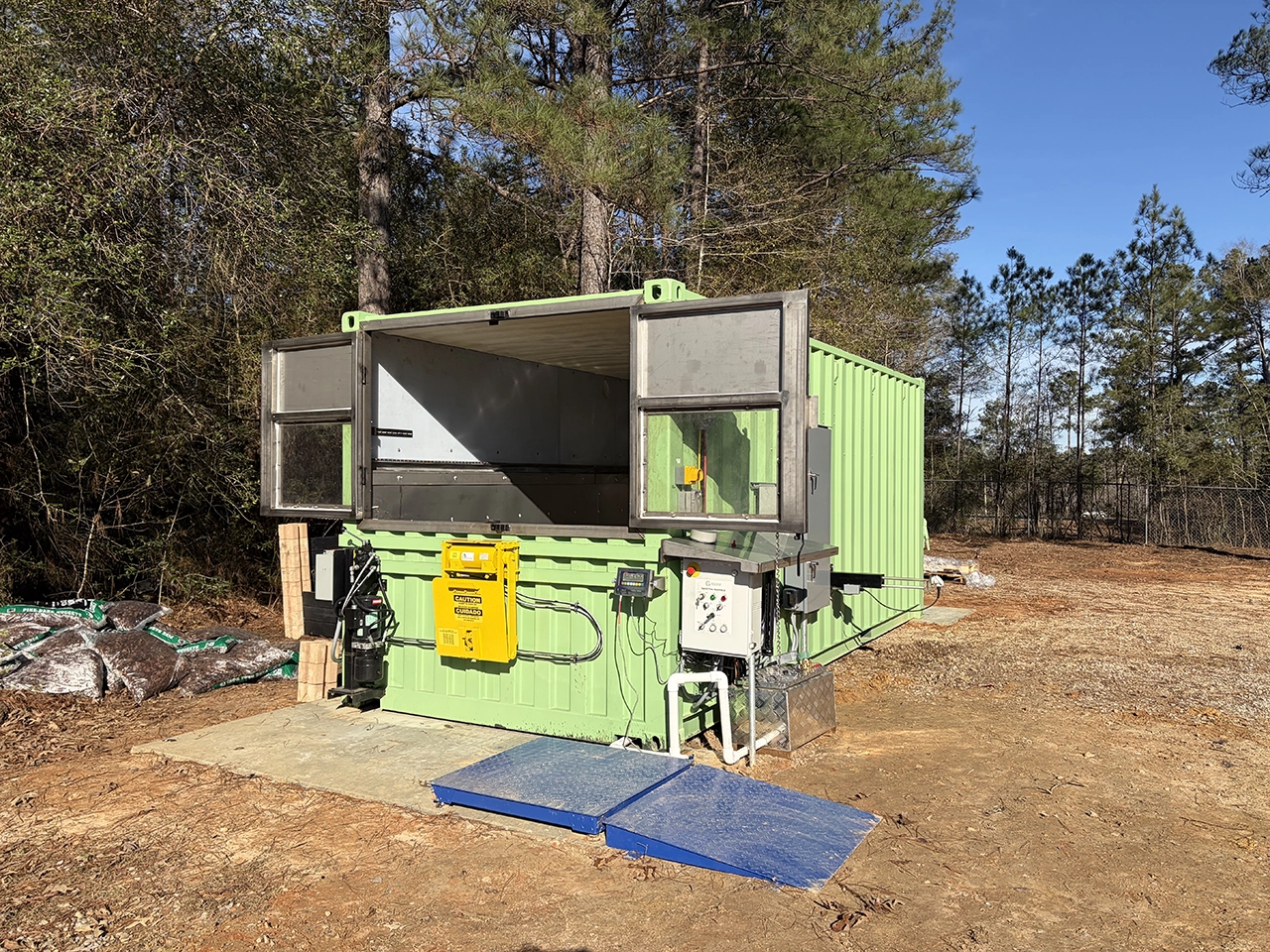
USM selected the Earth Flow IM20 in-vessel system from Green Mountain Technologies, primarily due to the system’s proven performance in breaking down bioplastics and other biodegradable polymers.
The Earth Flow IM20 provides a consistent and repeatable environment, allowing USM researchers to move beyond theoretical modeling and observe how new polymers behave in a true-to-life commercial setting. This level of control is essential for providing industrial partners with reliable data on how certified food-contact biopolymers and fiber-based packaging perform during the composting process.
The selection of the Earth Flow is further supported by industry-wide data. The 2024 Composting Consortium report, "Breaking It Down: The Realities of Compostable Packaging Disintegration in Composting Systems," validated the efficacy of this technology. Based on an 18-month field test of 23,000 units across 10 diverse North American facilities, the report found that Earth Flow systems produced some of the highest-rated results for the successful breakdown of compostable materials.
By integrating the Earth Flow IM20 into their facility, the University of Southern Mississippi is bridging the gap between polymer innovation and real-world environmental sustainability.