
ASP Composting
Operator: City of Hutchinson, MN
Location: Hutchinson, MN
Feedstock: Food Waste & Green Waste
Capacity: 1,500 T/year
Year Installed: 2024
Project Components:
Location: Hutchinson, MN
Feedstock: Food Waste & Green Waste
Capacity: 1,500 T/year
Year Installed: 2024
Project Components:



Client’s Requirements
Creekside Soils is a municipal composting facility operated by the the City of Hutchinson, MN. The City has operated a city-wide curbside Source-Separated Organics Materials (SSOM) diversion program since 2001, making it one of the oldest SSOM diversion programs in Minnesota. It is a standard offering program, meaning that all 4,000+ single family households can put their SSOM (both food and yard wastes) into their organics bin for year-round weekly curbside collection.
Between 2001 and 2024 these collected materials were composted in 16 “Containerized Composting Systems” from GMT. Creekside also composts yard wastes in turned windrows and produces landscape mulches from received wood wastes, producing widely popular bagged soil and mulch products that are sold over a 14 state area.
The main goal for the new composting system was to update the 23 year old in-vessel composting system with increased capacity and efficiency. The in-vessel system was effective, but after 23 years it would have required significant investment to replace worn out components. When exploring their options they concluded that the best path was an efficient new Covered Aerated Static Pile (CASP) composting system, with increased capacity and better operational efficiency.

Our Solution
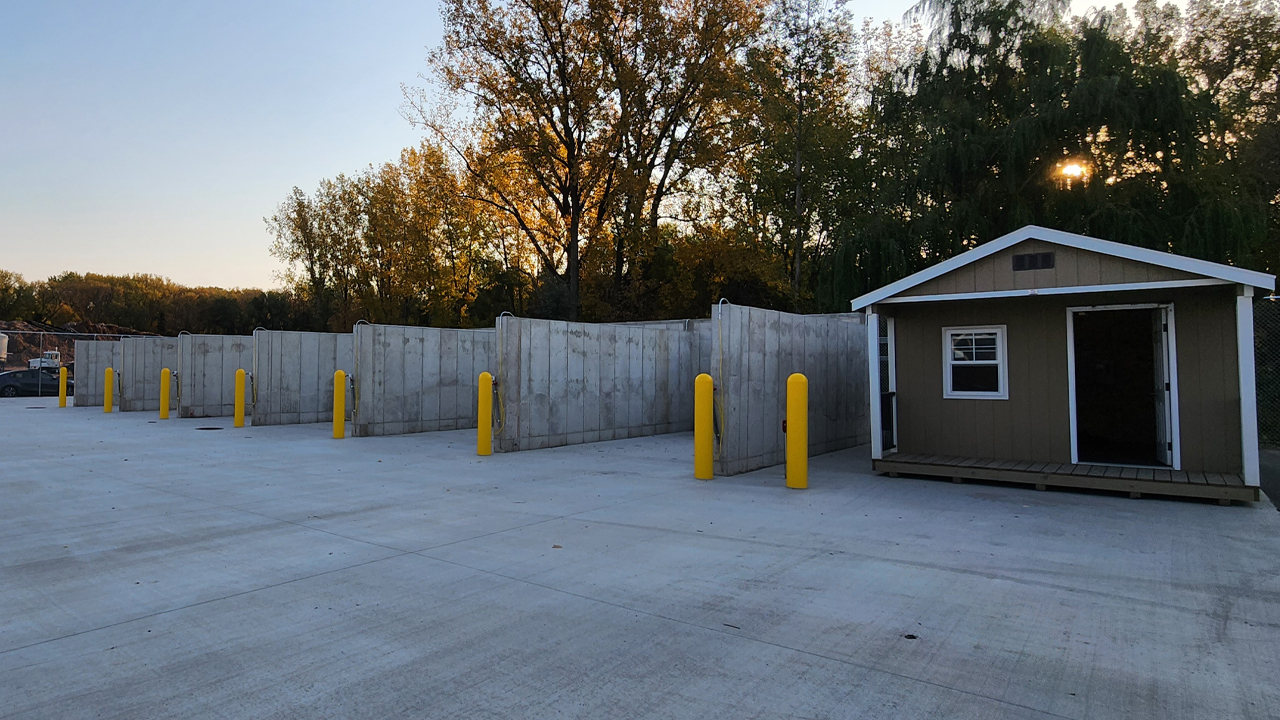
GMT designed and commissioned a 6 zone below grade CASP composting system, sized to Creekside’s volume and operating needs. Each zone has an individual blower that is directly controlled by temperature feedback from a data probe inserted into each pile.
The system substantially reduces operational costs while providing a model to be replicated for future expansion.
The CASP system enables Creekside Soils to produce high quality compost with minimal operating costs by utilizing state of the art temperature control feedback to keep pile temperatures at the ideal levels and maintain optimal composting conditions at all times. The aeration control system also minimizes odors and volatile organic compounds like methane, which are problematic when oxygen levels are too low in composting material.
Additionally, the below-grade aeration floor requires minimal operational interference between batches, allowing the operators to quickly load and unload batches without any adjustment to equipment. The facility was designed and positioned in a manner to allow the system to be expanded to 3,000 tons per year at a later date.
“Once our project finally came to fruition and construction started, GMT staff were very responsive and accommodating to our needs. From the initial design, to system component delivery and ultimately system commissioning, everything went as smoothly as one could expect. After a couple days of the project manager/engineer, Peter Haun, being on site for commissioning, only very minor changes were needed to be made to the control settings, it was like the system was “out of the box” ready. Not that I ever doubted the system’s performance, but I am very pleased with how the system controls are set and able to hold temps.”
- Andy Kosek, Creekside Soils General Manager, City of Hutchinson MN
Contact Us